Our project has started to come to life in ways that feel real. We recently put up flyers at the local Ladders in downtown Plymouth and at Step Ladders, and people are already scanning the QR code. The responses have slowly started coming in, and it’s so cool to see people upload photos of their favorite thrifted finds and share short captions about why they chose them. Those photos will become part of our digital mood board called The Ladder Effect. It’s a space where we can show how style, emotion, and community all connect through the Ladders thrift shop. Seeing this engagement has made me think more deeply about how psychology and marketing both play a role in the story we’re telling.
Our research helped us understand that thrifting is not just about affordability or sustainability, it’s also emotional. In the article The Not-So-Fashionable Side of the Thrifting Industry, Nikki Palella explains that “less than 10 percent of clothing donations are actually sold in stores” (Palella, 2021) most are even sent overseas. That fact made me realize that the real heart of our project shouldn’t be about donation at all, but about the meaning and reuse of clothing that already exists in our community. Thrifted pieces hold memories and identity, and when people share those pieces through The Ladder Effect, they are also sharing part of who they are. This shows the Habit of Mind integrative perspective, because our project is combining sustainability, psychology, and visual storytelling in a way that feels connected and purposeful.
From the psychology side, we’ve learned about enclothed cognition, the idea that what we wear can influence our mood, confidence, and behavior. This concept explains why so many people describe feeling “like themselves” when they wear something thrifted that tells a story. Even though the responses are still coming in, it’s already clear that clothing is deeply emotional and tied to personal identity. The photos we hope people will continue to upload will highlight how self-expression can connect to sustainability and community. This insight reflects the Habit of Mind self-regulated learning, since we’re adapting our project in real time based on how people are responding and what they choose to share.
The marketing connection has been just as interesting. Our flyers and mood board are not traditional advertisements, they are community storytelling tools. Instead of trying to sell something, we are creating engagement by letting real people represent the brand. This is a form of community marketing and user-generated content, where authenticity becomes the campaign itself. Research on sustainable marketing shows that people connect more deeply with visuals that feel personal and genuine. That’s what we’re aiming for with The Ladder Effect. We want to show real thrift joy, color, creativity, and belonging through the way people express themselves. It’s the Habit of Mind purposeful communication in action, because every design and post is meant to share a feeling, not just a message.
Reading about the decision making process explains that teams using a consensus approach need to make sure “..every individual has an opportunity to participate…” (Stein, n.d.) We used that model when deciding how to collect and present our data. Each member shared ideas for the flyer prompts, layout, and social media plan, and we made final choices together. That teamwork shaped how we launched the QR flyers and how we’re building the digital mood board. It showed me how psychology and marketing don’t just shape the project itself, they also shape how we work as a team to bring it to life.
As we continue collecting photos and reflections, I can see how this research has completely shaped our vision. The Ladder Effect isn’t just a mood board about thrift fashion, it’s a reflection of how people feel when they find something that represents them. It’s design that expresses community, identity, and emotion. Every photo and quote that gets added to it shows a small piece of what makes Ladders special. That mix of research, creativity, and emotion is what makes this project meaningful to me and what makes it more than just a class assignment.
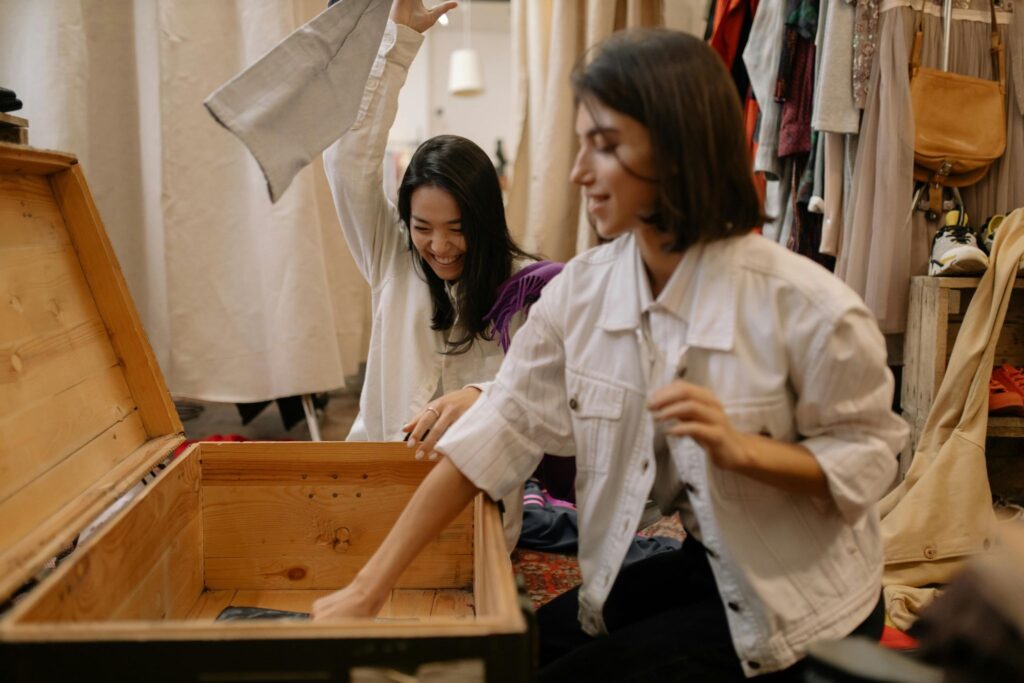
Photo by cottonbro studio on Pexels. “Women Removing Clothes From the Chest” [Photograph]. Retrieved from https://www.pexls.com/photo/women-removing-clothes-from-the-chest-6069557/
Palella, N. (2021, October 1). The not-so-fashionable side of the thrifting industry. Q Magazine, University of Illinois. https://q.sustainability.illinois.edu/the-not-so-fashionable-side-of-the-thrifting-industry/
Stein, J. (n.d.). Decision-making models. Massachusetts Institute of Technology Human Resources. https://hr.mit.edu/learning-topics/teams/articles/models
Leave a Reply